
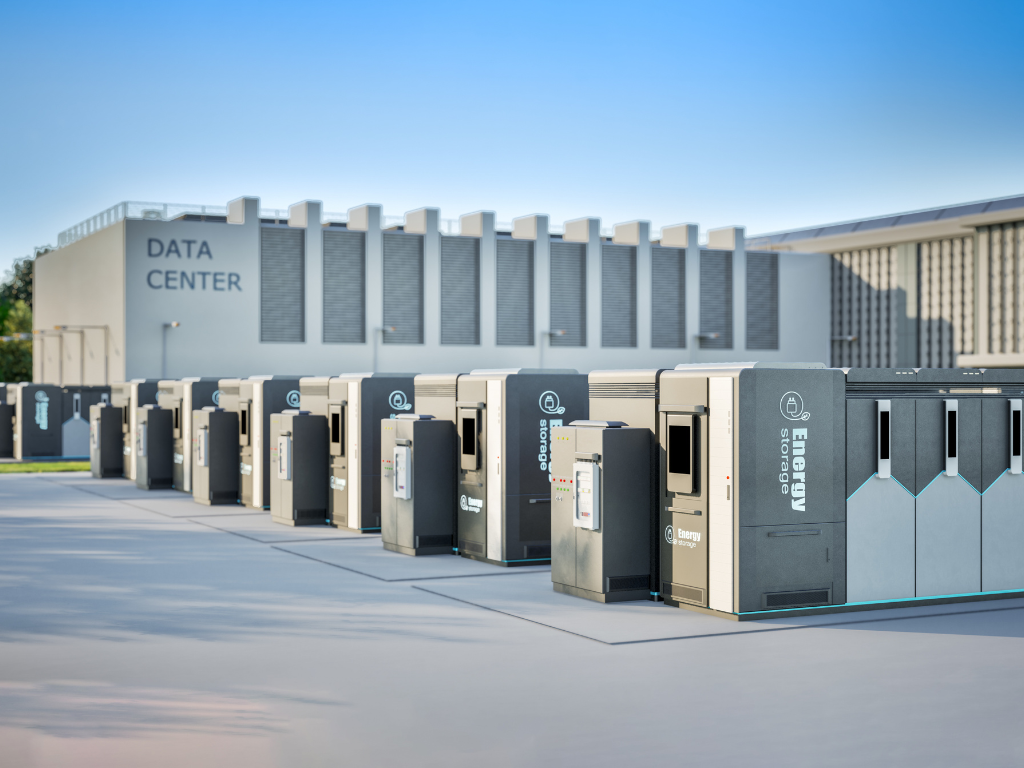
Thermal energy storage data centre projects have shifted from nice-to-have to budget lever, now that cooling can swallow 30 to 40 percent of a facility’s electricity. This blog walks you through how a chilled water storage system moves that load off-peak to cut cost, and how the same tank buys 15 to 30 minutes of backup cooling when a chiller trips or a power feed drops out.
What is thermal energy storage in a data centre, and how does it work?
Thermal energy storage (TES) is a chilled water battery for a cooling plant. Chillers run when electricity is cheap, usually overnight, and charge a large insulated tank with cold water. During the costly afternoon peak, that stored coolth is discharged to the precision cooling systems instead of running the chillers hard. The mechanism is a charge and discharge cycle against a thermal mass.
The tank itself does the clever part. Inside a stratified tank, warm return water and cold supply water separate by density and meet at a thin boundary called the thermocline. A well-built stratified tank holds a sharp thermocline so the cold layer stays cold until it is needed. Chilled water carries cooling as sensible heat at roughly 1 Btu per pound per degree Fahrenheit, which is why these tanks are large and why a wide supply-to-return temperature difference matters.
This is not a fringe idea. The US National Renewable Energy Laboratory puts cooling at as much as 40 percent of a data centre’s annual energy, which is exactly the cost base TES targets.
How does thermal energy storage cut data centre cooling cost?
It cuts cost by moving the chiller’s electricity draw from expensive hours to cheap ones, a practice called load shifting. The chiller still does the work, just at a better price and a steadier load.
For a large Singapore facility the saving is concrete. Data centres that buy on the wholesale market settle every half hour at the Uniform Singapore Energy Price, which sat in the S$100 to S$200 per MWh band through 2025 but climbs well above that during afternoon demand peaks. Charging the tank overnight at the price trough and discharging through the peak is direct arbitrage on the single biggest line in a cooling budget. There is a second saving that buyers often miss: a chiller charging at night runs at cooler ambient, so its coefficient of performance improves, and it runs at a flat load instead of short-cycling.
Worth being precise here, because plenty of articles overstate it. TES does not, by itself, slash PUE. PUE is a ratio of energy, and load shifting mostly moves energy in time rather than removing it. The headline wins are lower time-of-use cost and lower peak demand. The efficiency gain is real but secondary, and it comes from steadier, cooler night operation.
How does thermal storage add backup cooling when power or a chiller fails?
The same tank doubles as a cooling reserve. When a chiller trips or a feed is lost, stored chilled water keeps flowing to the halls while the plant recovers. CITEC sizes this reserve to hold 15 to 30 minutes of full cooling, enough to ride through a chiller restart or the gap before generators stabilise.
That gap is where data centres actually fail. Andy Lawrence, founding member and executive director of research at Uptime Institute, is blunt about the dominant cause: “Every year, a power failure is the number one cause, and I stress it’s not a grid power failure. This is more to do with a problem with the UPS generator starting, or a transfer switch failure.” Uptime’s 2025 analysis puts power at around 45 percent of impactful outages, with UPS, transfer-switch and generator faults leading the list.
Here is the part teams underestimate. A data centre UPS system protects the IT power, not the cooling. When chilled water stops in a high-density hall, rack inlet temperatures climb fast and the room can leave the ASHRAE recommended envelope before a generator has finished its start sequence. Cooling has no equivalent of the UPS battery unless you build one. A charged TES tank is that battery.
Chilled water or ice storage, which suits a Singapore data centre?
For most Singapore facilities, chilled water is the right call. It bolts onto the existing chiller plant and CRAH loop, needs no exotic low-temperature equipment, and keeps the system simple to operate and maintain. The trade-off is size, because chilled water stores cooling as sensible heat and the tank is large.
Ice storage is denser. Freezing water absorbs about 144 Btu per pound of latent heat, so an ice tank holds far more cooling in a smaller footprint. The cost is complexity: ice needs low-temperature chillers running glycol, and those chillers lose efficiency while charging. In practice, ice earns its place on space-constrained new builds, while chilled water wins on retrofits and on most colocation halls where the chiller plant already exists. The cleaner approach for an operating facility is almost always chilled water against the installed plant.
How is a thermal energy storage system sized for a data centre?
Sizing starts with the cooling load and the discharge duration you need, expressed in refrigeration tons and ton-hours. One Rton equals 3.517 kW of cooling. A tank rated for 1,000 ton-hours delivers 1,000 Rton for one hour, or 2,000 Rton for thirty minutes, so the backup window and the load set the tank volume together.
The number that actually governs the design is the peak demand profile, not a nameplate figure. We measure how the hall draws cooling across a day, then match tank capacity, charge rate and chiller plant so the discharge covers the peak and the overnight charge finishes before the next morning. Getting the supply-to-return temperature difference right is what keeps the tank compact, since pumping energy rises with the cube of flow. Before committing tank size, CITEC validates the result with heat load testing to confirm the plant performs under realistic thermal stress, and with computational fluid dynamics modelling to confirm the stored coolth reaches the racks that need it.
Does thermal energy storage help meet Singapore’s PUE and Green Mark targets?
Yes, mostly through peak demand and part-load efficiency rather than a single PUE number. Singapore’s regulator has set a clear bar: the IMDA Green Data Centre Roadmap targets a PUE of 1.3 or lower at 100 percent IT load across all data centres over the next decade . The 2024 refresh of the BCA-IMDA Green Mark for Data Centres scores efficiency at 25, 50, 75 and 100 percent IT load, which rewards designs that hold efficiency across the day.
TES supports that scoring in two ways. It lets chillers run at their efficient night point and flat load, and it cuts the peak draw that strains both the plant and the grid connection. With Singapore opening only about 200 MW under the December 2025 capacity call and roughly 1.4 GW already running across more than 70 facilities, every megawatt of peak demand avoided is a real constraint eased. For an operator chasing Green Mark and a grid allocation, that combination matters more than a decimal point on a brochure.
Conclusion
Thermal energy storage earns its place because one asset does two jobs. It shifts the chiller’s electricity draw to the cheap overnight window and trims peak demand, and the same charged tank rides through the chiller restart or power transfer that causes most data centre outages. In Singapore’s wholesale-priced, PUE-constrained market, that dual return is hard to beat with another chiller or a larger UPS.
If your facility is fighting afternoon energy cost, chiller short-cycling, or a thin cooling margin during power events, request a feasibility review and CITEC’s engineers will size a chilled water TES against your measured load profile.
FAQ About Thermal Energy Storage Data Centre
Can thermal energy storage be retrofitted to an existing data centre?
Yes. CITEC assesses the installed chiller capacity and the chilled water distribution layout, then integrates a tank into the operating plant. Retrofits are the common case in Singapore, because chilled water TES connects to equipment that is already there rather than requiring a new low-temperature plant.
Is thermal storage better than adding another chiller or a bigger UPS?
For peak cooling and ride-through, often yes. A tank is an economical alternative to extra mechanical cooling capacity bought only for the daily peak, and it covers a failure window a UPS cannot, since a UPS protects IT power and not chilled water. A bigger UPS does nothing for a chiller trip.
Does thermal storage reduce chiller short-cycling and wear?
Yes. Discharging the tank during demand spikes lets chillers run at a steady load instead of rapid on-off short-cycling. Fewer start cycles extend chiller lifespan and lower maintenance cost, which is one reason CITEC pairs TES with stable plant control.
What maintenance does a thermal storage tank need?
A stratified chilled water tank is low-maintenance: water treatment, insulation checks, and verification that the thermocline stays sharp through each charge and discharge cycle. CITEC folds tank checks into a single lifecycle maintenance programme alongside the chillers and CRAC units.
