
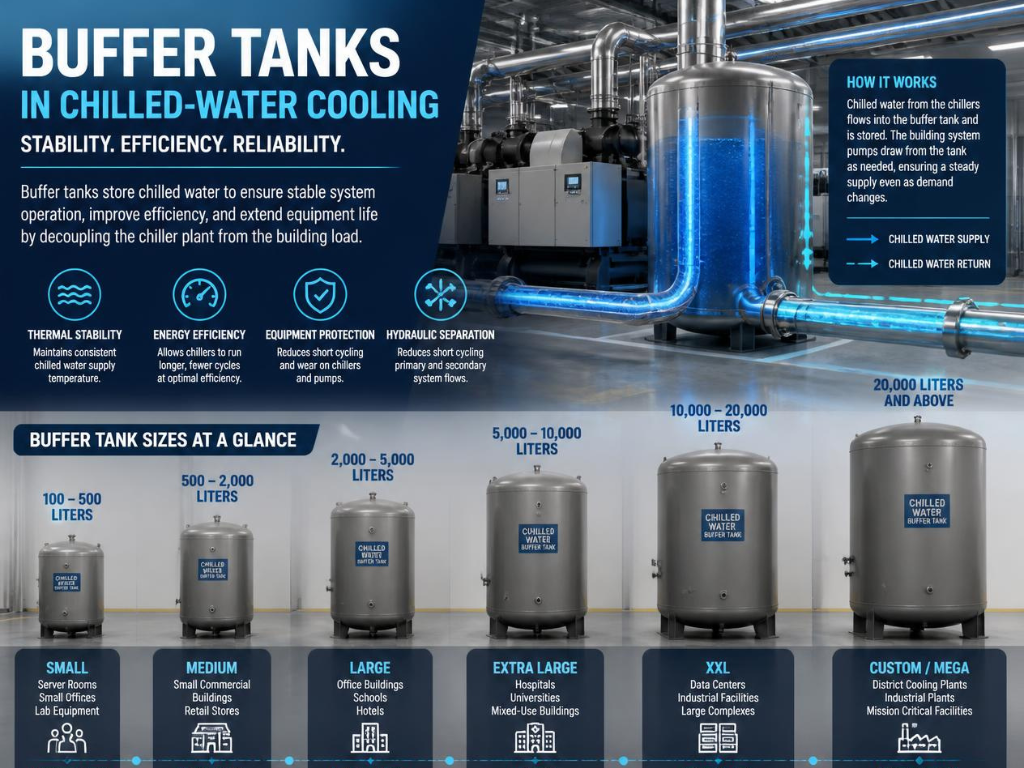
A buffer tank is the cheapest insurance in a chilled water plant, and the most misunderstood. Get the loop volume wrong and the chiller short-cycles, because many compressors are limited to roughly three to six starts per hour. This blog walks you through when a chilled water system actually needs a buffer tank, how to size one, and how it fits a precision cooling system design.
What is a buffer tank in a chilled water cooling system?
A buffer tank is an insulated tank that adds water volume to a chilled water loop so the chiller runs a full cycle instead of short-cycling. Its job is system inertia. More thermal mass means the return water temperature changes slowly, which gives the chiller time to complete a proper run before the return temperature hits the cutoff and trips it off.
A short-cycling chiller is an expensive chiller. Every start pulls a large inrush current, shocks the refrigerant circuit, and stresses the compressor before oil pressure stabilises. Water carries this inertia at 8.33 pounds per gallon, so even a few hundred gallons changes how long the loop holds temperature. Cycle time rises in step with loop volume, so roughly doubling the water doubles how long the chiller runs before the return water reaches its restart point. The tank changes the time, not the load or the setpoints. With cooling already taking as much as 40 percent of a data centre’s annual energy , a chiller that cycles rather than runs steady wastes money twice, once on wear and again on poor part-load efficiency.
When do you actually need a buffer tank?
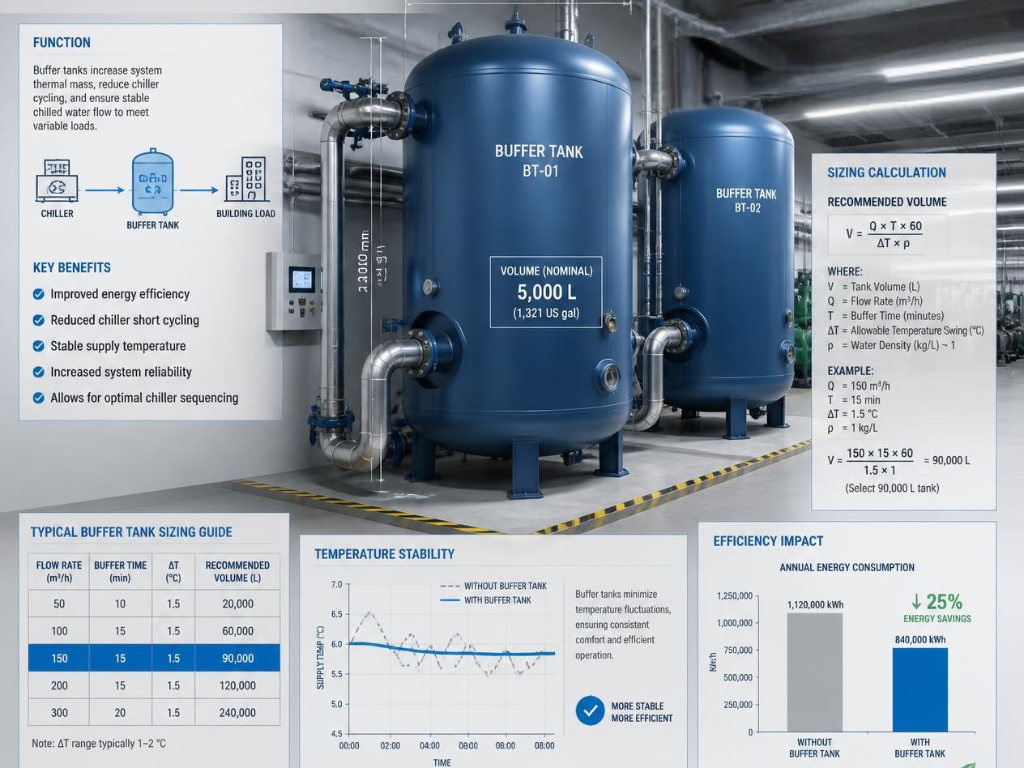
You need a buffer tank when the loop holds less water than the chiller needs to run a stable cycle. The practical test is loop volume, and the chiller maker sets the bar. Trane’s guidance is blunt: the chilled water loop “should be at least two minutes” of volume, and if it cannot be, a tank or larger header should be added.
Three situations push a loop under that line. Close-coupled plant rooms and rooftop air-cooled chillers run short pipe runs with little water. Variable-speed chillers turn down to around 10 percent of capacity, and that small output overwhelms a small loop. Mission-critical halls see chilled water flow swing 20 to 40 percent in seconds as IT load spikes. In practice, the loop that needs a buffer tank most is the modern data centre loop, not the big campus loop, because the campus has hundreds of metres of pipe doing the buffering for free. A quick screen before any calculation: if the plant room is small, the pipe runs are short, and the chiller is a single low-minimum machine, assume a tank is needed. If hundreds of metres of distribution pipe already sit in the loop, measure before you spend.
How do you size a buffer tank?
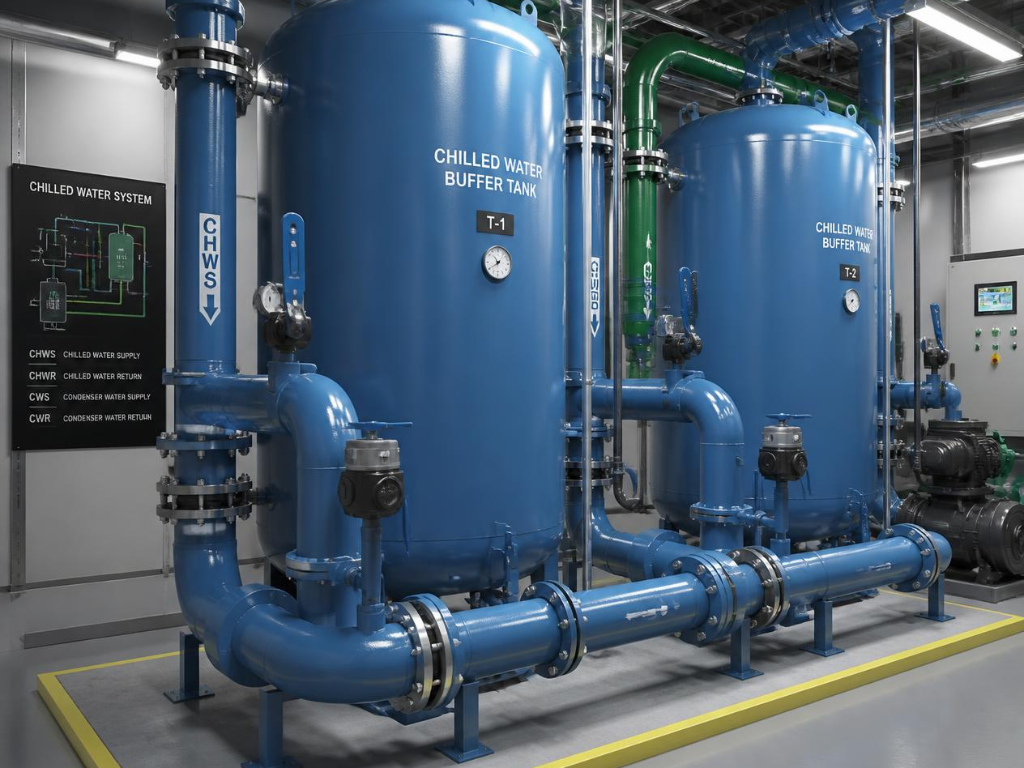
Size a buffer tank by subtraction. Work out the system volume the chiller needs, measure what the loop already holds, and the tank makes up the difference. Required system volume equals chiller tonnage times the recommended volume per ton, which runs 3 to 6 gallons per ton for comfort cooling and 6 to 10 gallons per ton when temperature accuracy is critical. Actual system volume is the pipe volume plus the terminal equipment volume.
A worked example makes it concrete. Take a 100-ton plant sized at 5 gallons per ton, so the required system volume is 500 gallons. The loop has 300 feet of 4-inch pipe, which holds about 0.66 gallons per foot, or 198 gallons, plus roughly 35 gallons in the equipment. Actual volume is 233 gallons, so the buffer tank needs to add about 270 gallons. Sizing should follow heat load testing that measures the real load and loop, not a nameplate guess. The 10 gallons-per-ton rule of thumb is a starting point, not a specification. Size against the smallest active chiller stage and an allowable control swing of 2 to 6 degrees Fahrenheit.
How does running multiple chillers change buffer tank sizing?
Size the buffer against the smallest chiller stage that can run on its own, not the full plant. A facility with two 300-ton chillers that stages one at a time has to stop that single 300-ton machine short-cycling at low load, so the volume target is set by 300 tons, not 600. Size for the plant total and the tank is too small the moment one chiller carries the load alone.
Staging strategy sets the rest. A plant that brings chillers on in coarse steps loads more swing onto each stage, which raises the volume that stage needs to ride out. Variable-speed machines soften this, since a chiller that modulates down to 10 percent can often hold the load without cycling at all, but the buffer still has to cover the gap while the next stage starts and ramps. In a data centre running N+1 redundancy, the tank also absorbs the transient when a failed chiller drops out and its partner takes over, which is exactly when flow and temperature move fastest. Worth noting: the smallest active stage, not the nameplate, is the number that sizes the tank.
Buffer tank vs storage tank, what is the difference?
A buffer tank holds minutes of water for hydraulic stability. A storage tank holds hours of cooling for load shifting. Same shape, very different job and size. A buffer tank gives roughly 1 to 3 minutes of reserve and is sized in gallons per ton, so a 200-ton chiller takes about 2,000 gallons.
A storage tank is sized in ton-hours, where volume equals cooling load in tons times discharge hours times 12,000, divided by 500 times the delta-T. The same plant’s thermal storage tanks run to tens of thousands of litres because they carry hours of load, not minutes. The stance worth keeping: do not buy a storage tank to cure short-cycling, and do not expect a buffer tank to ride through a power event. They solve different problems.
How does a buffer tank stabilise flow and protect the chiller and pumps?
In a variable-flow system, the buffer tank decouples the chiller loop from the distribution loop, so swings in distribution flow never starve the chiller. Sited on the primary loop at the primary-to-secondary interface, baffled, on the return side, the tank absorbs the flow difference as distribution valves modulate.
This matters because reduced secondary flow reaching a chiller risks minimum-flow violations, evaporator freezing, refrigerant migration and compressor damage. ASHRAE’s control guidance for high-performance plants sets minimum chiller flow protection precisely to avoid this . The decoupling is most valuable feeding fan array CRAH units in a data centre, where rapid IT load changes throw flow around. One stance from the field: in a variable-flow system, do not reach for a 3-way valve to hold minimum flow. It wrecks the delta-T. Add volume and decouple properly.
Conclusion
A buffer tank is not a storage tank and not a luxury. It is the volume that keeps a chiller running a clean cycle, and the decoupler that protects pumps from variable flow. On a modern data centre loop it earns its place faster than on any campus system, where long pipe runs already do the buffering. Size it against measured loop volume and the smallest active chiller stage, not a single rule of thumb.
If your chiller is short-cycling or your plant room runs a low-volume loop, review your chilled water loop with CITEC’s engineers before you specify a tank.
FAQ About Buffer Tank
What size buffer tank do I need for a 200-ton chiller?
Around 2,000 gallons as a starting point, using the common 10 gallons-per-ton rule, then validated against the chiller’s minimum output and existing loop volume. A variable-speed chiller that turns down to 10 percent needs more, since the low output overwhelms a small loop. CITEC sizes against the smallest active chiller stage.
Can I use bigger pipe or a larger header instead of a buffer tank?
Yes, if the extra pipe or header adds enough volume to reach the chiller’s minimum, which Trane puts at two minutes of loop volume. In tight Singapore plant rooms that is rarely practical, so a baffled buffer tank on the return is the cleaner fix. A tank also adds mixing that straight pipe cannot.
Does a buffer tank waste energy?
No. A well-insulated buffer tank loses very little heat, while a short-cycling chiller loses far more through compressor wear and poor part-load efficiency. The short-cycle saving outweighs the standby loss. CITEC folds tank insulation checks into lifecycle maintenance so the loss stays negligible.
What standard should a chilled water buffer tank be built to?
A pressurised buffer tank above 15 psig is built to ASME Section VIII Division 1, with hydrostatic testing at 1.3 times the maximum allowable working pressure and a U-stamp. CITEC specifies certified tanks with full material traceability for mission-critical chilled water loops.
