

Fan wall vs CRAC is the question most data hall designs answer out of habit, copying the last build instead of the current load. With racks now drawing 10 to 30 kW each, that habit gets expensive fast. This blog walks you through how fan array cooling stacks up against a traditional CRAC, the point where each pulls ahead, and how the choice sits inside a modern precision cooling system.
What is the difference between a fan wall and a CRAC unit?
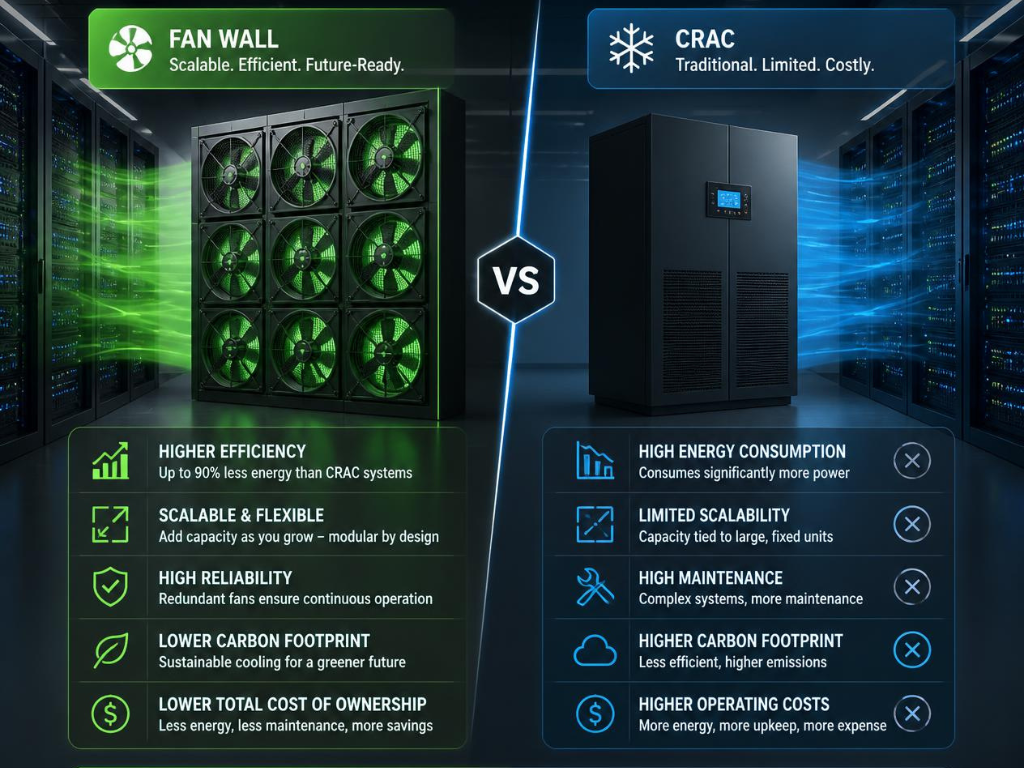
A fan wall is a bank of small EC plug fans running in parallel behind a cooling coil. A CRAC is a self-contained box that makes its own cold with a refrigerant circuit and moves air with one or two large fans. Said precisely, a CRAC carries a DX compressor, a CRAH runs on chilled water, and a fan wall is normally a CRAH fitted with an array of fans rather than a single big one. The labels blur in conversation, but the choice underneath them sets how the room behaves.
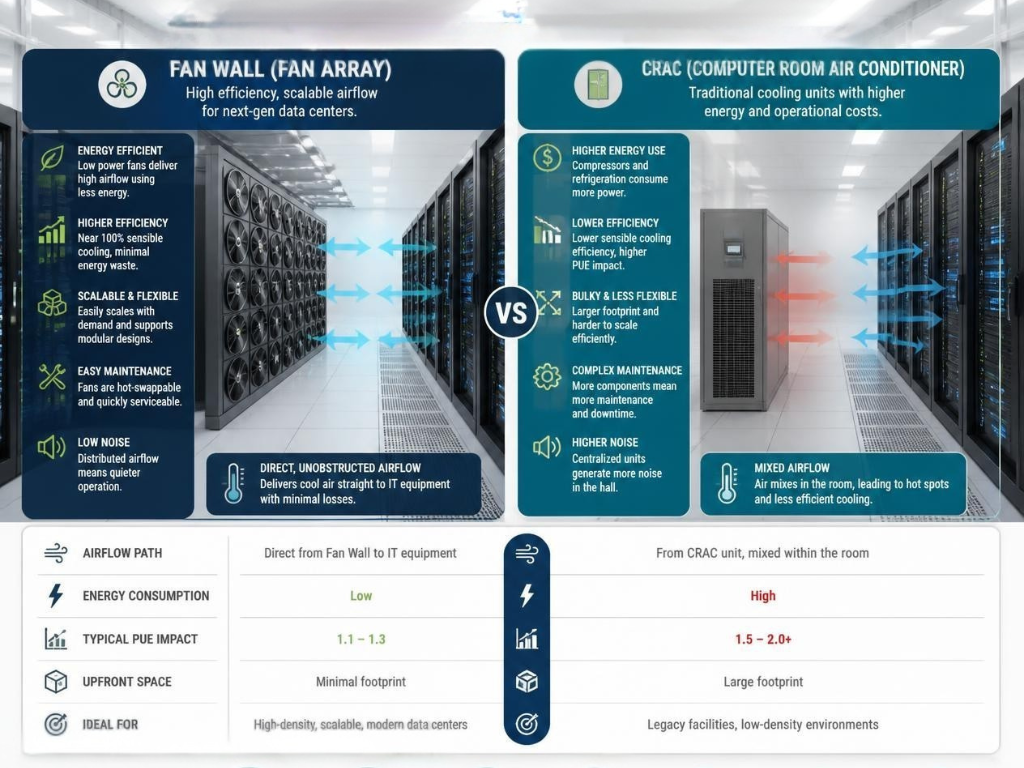
Airflow is where the gap shows. A conventional CRAC or CRAH leans on a handful of forward-curved fans and a raised-floor plenum to move air. A fan array spreads the same volume across a wide discharge face at low velocity, holding steady static pressure up the full height of a cold aisle. CITEC’s CFAC fan array runs a flooded-aisle layout with no raised floor and a short air path, so it feeds tall, dense racks without the ceiling-height and pressure ceilings a downflow CRAC runs into. When the question is whether the air actually reaches every rack, CFD airflow modelling answers it before a single unit is ordered.
Is a fan wall more efficient than a CRAC?
Usually, and the saving lives in the fans rather than the coil. Because fan power tracks the cube of speed, a fan trimmed to 80 percent of full speed pulls only about half the power. A fan array banks that effect by spreading the duty across many EC plug fans turning slowly, instead of a few large fans running hard. Fans on a CRAC unit draw 5 to 10 percent of a data centre’s total electricity, and cooling as a whole takes as much as 40 percent, a share documented in the National Renewable Energy Laboratory’s data centre cooling research, so the fan decision lands straight on PUE.
The field numbers back this. Kris Holla, Group Vice President at Nortek Air Solutions, reports that fan arrays “can save up to 35% in energy versus single, large fans,” particularly with EC fans specified. For a Singapore operator working toward the Green Mark goal of PUE 1.3 or lower at full IT load, set out in Singapore’s Green Data Centre Roadmap from the IMDA, that part-speed efficiency is not optional. It is what carries the building through its part-load checks at 25, 50, 75 and 100 percent.
How does fan array redundancy compare to CRAC redundancy?
A fan array carries its redundancy across many fans, so losing one barely moves the needle. Drop a single fan in a twelve-fan array and roughly 8 percent of the airflow goes with it, while the other eleven speed up to hold setpoint. A CRAC handles redundancy a whole unit at a time, where one fan or compressor fault can pull the entire box out of service, which is why CRAC rooms run full standby units.
That changes the spare-capacity math. In a fan array the N+1 sits inside the cabinet, and CITEC’s CFAC is built modular and stackable precisely to pack the most redundancy into the least floor. Fan optimisation logic manages the handover, engaging the remaining fans automatically to keep the setpoint when one drops. EC plug fans add to this, since each runs at variable speed with no separate drive and slots into N+1 or 2N schemes for mission-critical halls. The upshot: a fan array hits the same resilience with less installed standby, which saves both capital and the floor space a row of backup CRACs would have eaten.
When should you choose a fan wall, and when is a CRAC still right?
Reach for a fan wall when density is high and chilled water is already on site. Past roughly 10 to 15 kW per rack in a sizeable hall, the array’s even pressure, part-speed efficiency and in-cabinet redundancy win clearly. Under about 5 kW per rack in a modest server room, or anywhere with no chilled water plant, a self-contained DX CRAC is the smarter buy: cheaper, simpler, and free of any central plant.
Two questions settle it, not precedent. Is there chilled water, and how dense are the racks. A fan wall is a CRAH, so chilled water is a prerequisite; a DX CRAC brews its own cooling and suits a room standing on its own. For extreme density right at the cabinet, in-row cooling units sit closer to the heat than either approach. Pin the decision to heat load testing that measures real load and density rather than a nameplate, because that density figure is the hinge the whole choice swings on.
Does a fan wall scale better for a growing data hall?
Yes, because the format is modular by design. An array is built from repeated fan cubes and stackable cabinets, so capacity goes in by increments as the hall fills rather than landing as oversized units on day one. CITEC’s CFAC is set up to favour either maximum capacity per footprint or maximum redundancy, whichever the site needs.
Two practical gains come with it. There is no raised floor to pour or maintain, which lowers first cost and lifts the ceiling-height limit that boxes in downflow CRAC layouts. Front access to the control panel, EC fan and filter lets a failed fan come out from the cold aisle with no rear clearance and no shutdown. For a colocation hall climbing from a few racks to a full row, that pay-as-you-grow, serviceable footprint is the line between funding cooling you do not yet use and matching spend to load.
How do fan walls and CRAC units compare on noise and serviceability?
A fan array runs quieter than a CRAC at equal duty, because a crowd of small EC fans moving air gently makes less noise than a couple of large fans working hard. Sound climbs steeply with fan speed, so the part-speed running that saves energy also drops the noise floor. In a hall where people work between the racks, that margin is felt.
Serviceability separates them further. CITEC’s CFAC opens from the front for the control panel, EC fan and filter, so a technician stays in the cold aisle with no rear access needed. A failed fan in an N+1 array swaps out while the unit keeps cooling, the rest holding setpoint. A traditional CRAC often has to be backed down or shut off for a fan or compressor repair, and plenty of layouts demand rear clearance the room never had. For a mission-critical hall, holding cooling live through a repair beats a slightly better efficiency figure. The cleaner approach is to design for the swap, not only the steady state.
Conclusion
Fan wall and CRAC are answers to different rooms rather than competitors. The fan wall takes the high-density hall with chilled water on efficiency, even static pressure and in-cabinet N+1. The self-contained CRAC still owns the small, low-density room with no central plant. What decides it is rack density and whether chilled water exists, not whatever the previous project installed.
If you are weighing fan array cooling against CRAC for a new or expanding data hall, compare options with our engineers and CITEC will model the call against your real load and density.
FAQ About Fan Wall vs CRAC
Is a fan wall more expensive than a CRAC?
A fan wall usually costs more to buy than a single CRAC but less to run over its life in a dense hall, since EC plug fans cut fan energy and there is no raised floor to build.
Can you retrofit EC fans into existing CRAC units?
Yes. Most precision units take EC plug fan retrofit kits, and the payback usually lands under three years on fan energy alone. It is the simplest efficiency upgrade for an ageing CRAC room. CITEC checks the installed units before advising a retrofit over a full fan array replacement.
Does a fan wall need a raised floor?
No. CITEC’s CFAC uses a flooded-aisle design that delivers cold air straight to the cold aisle without a raised floor, removing the ceiling-height limit and trimming first cost. Traditional downflow CRAC units, in contrast, rely on a raised-floor plenum to spread air.
What maintenance does a fan array need?
Routine EC fan and filter checks, both reached from the front, plus controls verification. Because the array runs N+1, one fan can be replaced without taking the unit offline. CITEC builds fan array servicing into its lifecycle maintenance for mission-critical cooling.
