
CRAC maintenance is the line item that looks skippable until a unit trips and a hall starts heating. Cooling faults already cause around one in eight impactful data centre outages, so a service schedule is uptime work, not housekeeping. This blog walks you through how a CRAC unit works, its service intervals, and how it differs from a CRAH, all under CITEC’s lifecycle maintenance programmes.
How does a CRAC unit work?
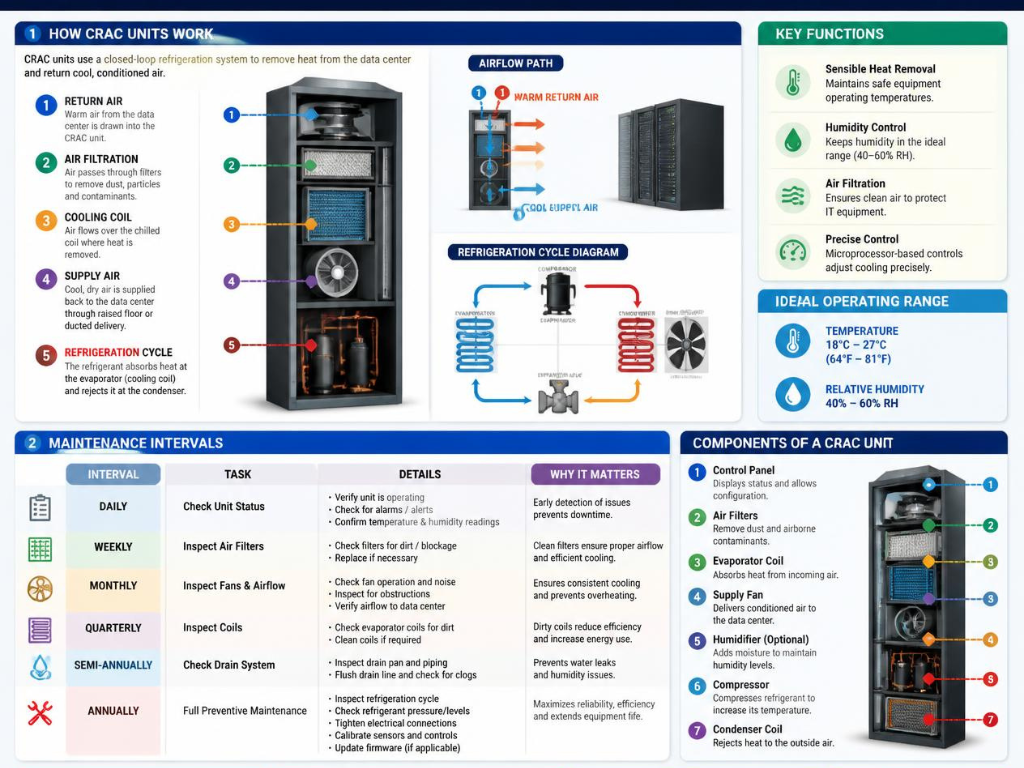
A CRAC, or computer room air conditioner, cools by pulling warm room air across a refrigerant coil, dropping its temperature, and pushing it back to the racks, usually through a raised floor. It runs a direct expansion cycle: a compressor circulates refrigerant, the indoor coil absorbs heat, and a condenser rejects that heat outside. The work is almost entirely sensible cooling, which lowers air temperature without stripping much moisture.
That sensible focus is the whole point. IT equipment throws off dry heat, so a precision unit targets a sensible heat ratio of 0.90 to 1.0, against 0.60 to 0.80 for the comfort air conditioning built for people. Run a comfort unit in a server room and it wastes capacity dehumidifying air that does not need it, burning up to 35 percent more energy for the same useful cooling. A CRAC is one of CITEC’s precision air conditioning units precisely because cooling can reach as much as 40 percent of a data centre’s energy, a share documented in the National Renewable Energy Laboratory’s data centre cooling research, and that load deserves a machine built for it.
What is the difference between a CRAC and a CRAH?
The difference is how each one makes cold. A CRAC carries its own refrigeration, a DX compressor and refrigerant circuit inside the unit. A CRAH, or computer room air handler, has no compressor; it passes room air over a chilled water coil fed by a central chiller plant, then returns the warmed water to be re-cooled.
That single difference drives everything else. A CRAH runs more efficiently because it drops the onboard compressor and uses variable-speed fans, which is why large facilities with a chiller plant favour it. A CRAC is self-contained and simpler to install, which suits smaller or standalone rooms. The common industry split puts CRAC units at data centre loads of 200 kW or less and CRAH units above that. The cleaner way to choose is to read the plant: if chilled water already exists and the load is large, specify CRAH; if the room stands alone with no plant, a CRAC earns its place.

Why does CRAC maintenance matter?
Because cooling is now a leading cause of downtime, not a background utility. Cooling-related failures account for roughly one in eight impactful data centre outages, according to Uptime Institute’s 2025 outage analysis. When cooling stops, the room does not coast. Uptime recorded a hall of 250 racks at 6 kW climbing from 22 to over 32 degrees Celsius in 75 seconds after a loss of cooling.
Most of these failures are preventable, which is the case for disciplined maintenance. Andy Lawrence, executive director of research at Uptime Institute, is direct about the dominant cause: “Every year, a power failure is the number one cause, and I stress it’s not a grid power failure. This is more to do with a problem with the UPS generator starting, or a transfer switch failure.” Those are maintainable components, and so are the compressors, coils and sensors inside a CRAC. CITEC confirms a serviced plant still meets its duty with heat load testing rather than assuming it does.
What does CRAC maintenance include?
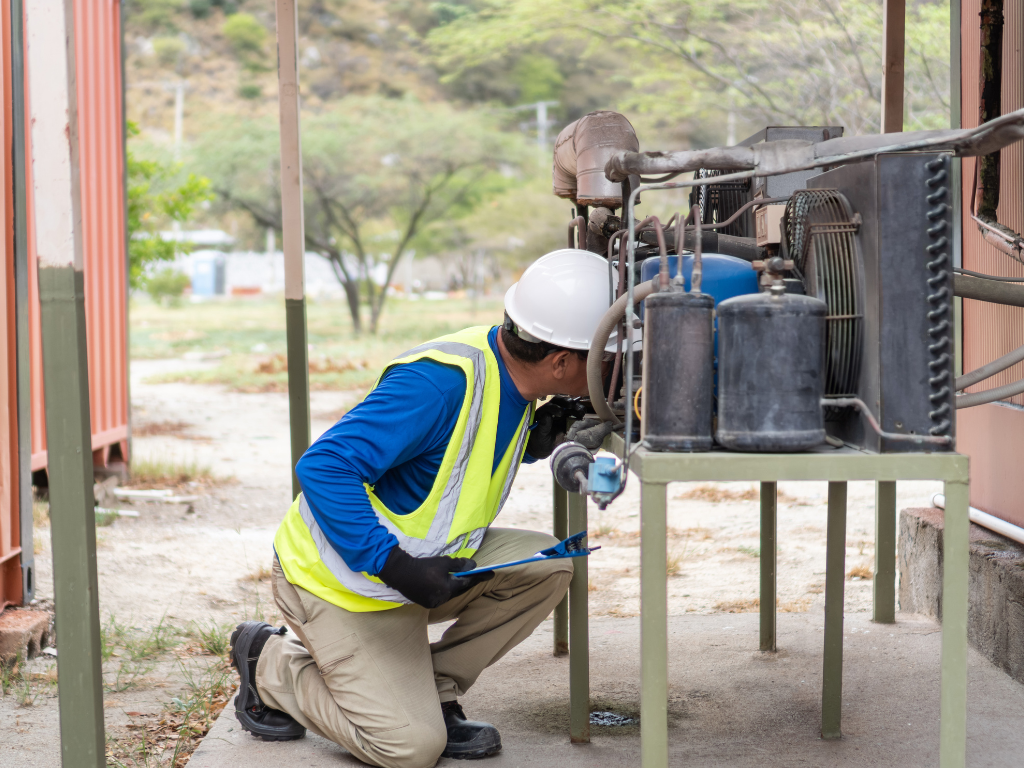
A proper CRAC programme covers the refrigerant circuit, the airflow path and the controls, in that order of consequence. On a DX CRAC, technicians check refrigerant charge, trend compressor current draw and oil condition, clean the condenser coil, and leak-test the circuit. Refrigerant work is regulated: under EPA Section 608 rules, only certified technicians may service equipment that could release refrigerant. A CRAH shifts the focus to the water side, where the control valve stroke, chilled water delta-T and coil fouling matter most, since there is no compressor to mind.
Both unit types share a common core. Filters, fan motors, humidifiers, condensate drains, and temperature and humidity sensors all need routine attention, and a drifting sensor quietly defeats precision control. Because a CRAH runs chilled water through the hall, condensate and pipe leaks are a live risk, which is why CITEC pairs cooling maintenance with leak detection systems. Where rack layouts have changed since commissioning, CFD airflow analysis confirms the conditioned air still reaches the equipment that needs it.
How often should a CRAC unit be serviced?
Run a tiered schedule, not a single annual visit. Filters get checked monthly and changed on a 30 to 90 day cycle. Quarterly visits cover fan motors, belts where fitted, sensor calibration, condensate, and a refrigerant or chilled water check. A deeper service every six to twelve months handles compressor diagnostics, coil cleaning and full controls verification.
Singapore tightens those intervals. The tropical climate loads condensers and filters harder than a temperate site, and high ambient humidity raises the duty on every unit, so condenser cleaning and filter changes earn a shorter cycle here than a generic schedule assumes. CITEC builds the plan around asset condition and criticality rather than the calendar alone, sends its service teams for annual factory training, and writes a performance management plan for each site. Worth noting: a fouled coil or a clogged filter does not announce itself. It shows up as creeping energy use and a thinner safety margin long before it shows up as a trip.
How do you maintain CRAC units without taking the data hall down?
You design the redundancy first, then schedule around it. A data hall is built with spare cooling so one unit can drop offline for service while the rest hold the room. The common configurations are N+1, meaning one unit beyond what the load needs, then N+2 for tighter halls, and 2N for full duplication on the most critical sites. Concurrent maintainability, the standard behind an Uptime Institute Tier III facility, means any cooling unit can be isolated and serviced with the IT load still running.
That spare capacity only protects uptime if the schedule respects it. Two redundant units pulled in the same window leave the room exposed, so CITEC staggers planned work and runs it under phased work planning with isolation and risk controls. Before a unit comes down, remaining capacity is checked against the live load, because an N+1 hall sitting near full load has no margin to give if a second unit faults mid-service. This is where calendar-only schedules fail. They treat every unit as interchangeable and ignore which ones are currently carrying the room.
The discipline pays back twice. A room that is concurrently maintainable never has to choose between a deferred service and a risky shutdown, which is how maintenance quietly slips on sites built without redundancy. A serviced unit returned to a balanced, validated room also behaves predictably, instead of masking a developing fault until the next load spike exposes it. Redundancy is a maintenance enabler, not only an outage cushion, and the two are the same investment seen from different angles.
Conclusion
A CRAC is a sensible-cooling machine doing one of the hardest jobs in the building, and it fails the way most data centres fail, through maintainable parts left unwatched. Whether the unit is a DX CRAC or a chilled water CRAH changes what gets serviced, not the principle: tiered intervals, condition-based judgement, and validation that the plant still meets its duty.
If your cooling units are overdue a proper review, book a maintenance assessment and CITEC will map the schedule to your site’s load and risk.
FAQ About Crac Maintenance
How much does CRAC maintenance cost, and is it worth it?
A planned maintenance contract costs far less than one outage, and Uptime Institute has found over 60 percent of data centre failures exceed 100,000 US dollars. Proactive servicing also recovers energy, since a fouled coil and clogged filters force a unit to work harder. CITEC scopes maintenance against asset criticality so spend tracks risk.
How long does a CRAC unit last?
A precision CRAC unit runs 15 to 20 years, and disciplined maintenance pushes it to the upper end of that range. Compressors and fans wear, but coils, frames and air paths last far longer. CITEC’s whole-of-life asset management plans replacement against condition, not just age.
What certification do CRAC maintenance technicians need?
Anyone handling refrigerant on a DX CRAC must hold EPA Section 608 certification under the US Clean Air Act, with equivalent rules applying in other jurisdictions. CITEC sends its service personnel for annual factory training so technicians stay current on the specific units they maintain.
What are the signs a CRAC unit needs servicing?
Rising supply air temperature, short-cycling, ice on the coil, unusual compressor noise and creeping energy use all point to a unit overdue for service. A drifting humidity reading is another tell. CITEC treats any excursion outside the ASHRAE 18 to 27 degree Celsius envelope as a prompt to inspect.
